NW Ferments

Which Sugar Should I Use for Water Kefir?

The Best Sugar Depends On The Result

When you make water kefir at home, the key ingredients are water kefir grains, water, and sugar. Each one of these ingredients impacts the outcome.  There are many choices when deciding which sugar is best for water kefir – what you choose to use depends on your desired result. 


We believe that organic white sugar combined with rapadura or other minimally processed sugar is the best option for water kefir. Supplementing with Rapadura or unsulphured molasses keeps our water kefir grains happier, healthier, and more productive because they contain the nutrients and minerals that the grains love.


Before we go into the types of good and bad sugars, make sure that you read the label when you buy your sugar. Some may contain anti-caking additives or even gluten! These can be bad for the health of your grains. If your water kefir or grains seem to be having issues, check out our other posts, “Water Kefir Grains Troubleshooting” and “Water Kefir Grains FAQ.”

Good: "White" Sugar

Evaporated cane sugar (light blonde in color) is the most popular for fermenting water kefir grains. We use this sugar when we make water kefir for our families or customers to sample, as the mildness of the light sugar allows the kefir to be easily flavored and is appealing to more people.


White sugar is processed using chemicals in refining, so no nutrients or minerals remain. Organic cane juice sugar or crystals aren’t as refined as white, so they have a low mineral content. Both kinds create a sweet water kefir.

Good: Rapadura Sugar

Rapadura (and similarly pressed cane sugars called sucanat or panela) is the least refined sugar. It’s produced by pressing the pure juice from the sugar cane, then cooking at low temps to evaporate the water. The end product includes molasses which holds vitamins, minerals, and nutrients. Because of this, the rapadura has a strong molasses-like taste making your water kefir less sweet and a more robust flavor. 

Good: Turbinado Sugar

Demerara, turbinado, and muscovado are considered “raw” sugars from the sugar cane plant. They are brown due to the naturally occurring molasses not being entirely removed during the refining process. By themselves, the sugars offer deeper flavors and aromas than white sugar but have a lower mineral content and make less sweet water kefir. Of these raw options, the best replacement for white sugar is turbinado sugar for water kefirs.

Bad: Brown, Molasses, And Other Sugar Substitutes

Water Kefir grains do best with the sugars mentioned above. But what about the other types of sweeteners out there? Brown sugar isn’t good because it’s refined white sugar with a usually unknown amount of added molasses. It’s better to make your own by combining white sugar and molasses. You can use small amounts of molasses to supplement mineral content if needed. Unsulphured dried fruits can be used, but they may impact the fermentation times.


Coconut palm sugar, maple sugar, or syrup are too rich and can damage the water kefir grains. Honey has bacteria that compete with the grains, and some brands may be contaminated by high fructose corn syrup! Avoid all artificial sweeteners as they offer nothing for the grains to feed on.


So which sugar should you use when making water kefir? We hope you consider all of this information – and then the choice is yours! Take good care of those babies, and they’ll do the same for you 🙂

Water Kefir Sugar FAQs

How Much Sugar Should I Add to Water Kefir?

Use three cups of water and ¼ cup sugar with your starter batch.  After that, we recommend you use ¼ cup of sugar to one quart of water as the optimal ratio.

What Happens to Sugar in Water Kefir?

Water kefir grains love to feed off of sugar. As it cultures, the grains -gelatinous, crystal-like globs of beneficial bacteria and yeast- convert the sugar into carbonation (CO2), turning into a wonderfully bubbly probiotic beverage.

How Much Sugar Is In Kefir After Fermentation?

The beneficial bacteria and yeast in the water kefir grains eat the sugars during fermentation, converting the glucose to glucuronic and other acids, thus reducing the end sugar content. So, the longer you ferment, the lower the sugar content. To accurately measure grams of sugar per 100ml, use a hydrometer.

Is The Sugar In Water Kefir Bad For You?

The sugar content in homemade water kefir is far lower than most soda pops or other fizzy drinks you buy at the store. Plus, all the beneficial probiotics add nutrition, whereas soda does nothing good for your health.  For people with diabetes, water kefir has a low to moderate glycemic index, which means it’s unlikely to cause blood glucose problems. Of course, you could use coconut water to lower the sugar content further – but be sure to alternate now and then to keep your grains happy and healthy.

Garlicky Kraut

Garlicky Kraut I don’t steer too far from the norm when it comes to sauerkraut, but I do love garlic...
Kicking it Making Kimchi

Kicking it Making Kimchi Kimchi can have many, many versions of itself…its origin is known to be Korea, and I...
Water Kefir Ingredients

Water Kefir Ingredients Water Kefir is one of the easiest cultured drinks to make. In addition to the grains, all you...
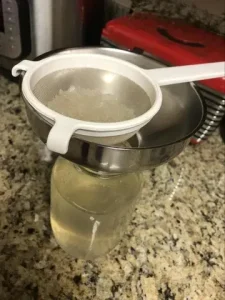
Water Kefir: Pop and Fizz!

Water Kefir: Pop and Fizz! The second fermentation  is a step many don’t realize needs to happen before you can get...
Sourdough Coconut Biscuits

Sourdough Coconut Biscuits These are the tastiest little “biscuits” made from a gluten-free starter. Be warned, it can get  very  sour, so...